Search this blog

Friday, July 8, 2011

Sports Through Edgren's Eyes (Robert Edgren, August 2, 1924)

1924-08-03 The Seattle Daily Times (Seattle, WA) (page S2)
Sports Through Edgren's Eyes
By ROBERT EDGREN.

Pasadena, Cal., Saturday, Aug. 2.--Are modern boxers in a class with the old timers?

Every week I get a box full of letters from old-time boxers or fight fans who claim that the up-to-date champion is a counterfeit when compared to the strong boys back in the eighties and nineties, and before that. Hardly a day goes by without an eight-page protest from some veteran who used to go out into the woods to see John L. Sullivan fight, or who followed Jack McAuliffe or Jack Dempsey, the Nonpareil, or who watched when Kid Lavigne battled Joe Walcott to a stand still, or saw Terry McGovern go through Pedlar Palmer of England like a cyclone. The old-timers are loyal to old-time fighters. They think that modern ringsters ought to be behind ribbon counters. According to old-timers the champions whom we have today don't know how to put their hands up and don't know what real fighting is.

Dempsey an Exception.

So far as I have seen, there's little physical difference between old-time champions and champions up to date. There are as good men now as there ever were in the ring. The chief difference is that old-time fighters weren't influenced so much by the thought that winning meant a fortune and defeat was a form of bankruptcy.

The fight was the great thing in the old days.

The money is the big thing today.

Old-time fighters fought desperately and recklessly.

Modern fighters are extremely cautious. They take no risk that can be dodged. A championship is something to be grabbed if possible, and then to be held as long as possible by outwitting the other fellows who are after it. Dangerous matches are avoided, and the modern champion is very fond of no-decision matches, in which he can run or stall and hold his title if he finds he can't win.

Jack Dempsey is the only champion today who fights with the reckless abandon of the old-timers. Dempsey doesn't know how to stall, and wouldn't if he could. He is the biggest money maker the ring ever knew, and he takes good care of the money he earns, but in the ring he always goes out to win in the first round if he can. He'll dive in and trade punches with any man living. Dempsey likes money, but he isn't crazy over it. Manager Jack Kearns handles all the business and Dempsey concentrates his mind on the training and the fighting.

But there were some desperate birds in the old days. Bob Fitzsimmons would have delighted in taking on Jack Dempsey, confident of outmatching him in the battle of wits and slipping in the winning punch. Fitzsimmons feared nothing on earth and was most dangerous when he reeled around the ring, apparently helpless. Many times Fitzsimmons was nearly knocked out and won with a punch. Peter Maher had him on the floor, cold, for eight seconds. He got up, staggered into Peter with his hands down, and knocked Peter out with one terrific blow as soon as he could lift them again.

Knocks Carter Down.

I saw Kid McCoy knocked down and nearly out by the great yellow-haired fighter, Kid Carter, saved by the bell, walk out in the next round and totter across the ring to meet Carter in his own corner. McCoy couldn't lift a hand from his sides. His gloves dangled as he closed with Carter and ducked to break the force of punches that grazed his ears. It was fully a minute in that third round before McCoy could get his hands up, and when he did he hit Carter a hook that threw him half way across the ring and headlong into the ropes.

Desperate fighting followed, in which McCoy was knocked down six times, yet in the sixth round he was still on his feet, was forcing the fighting, and had Carter groggy and cut to pieces. McCoy was the cleverest boxer of his day, but desperate at all times. If he had come along now probably he would have been like most of the champions we see, a cautious business man.

Kid Lavigne at Maspeth, fighting the Barbadoes Demon, Joe Walcott, had both ears nearly torn off by blows, his eyes closed, nose broken, teeth splintered. Still he rushed and fought until Walcott broke under the fierce pace and backed away, beaten.

In his fighting prime Terrible Terry McGovern was knocked down just once--by Oscar Gardner. The blow dazed McGovern so that he was helpless. But the instinct to get up was so strong that when he couldn't shove himself from the floor he crawled to where Gardner stood waiting for him, and climbed up Gardner's legs to renew the fight. As soon as he was up, Terry began fighting again with a Berserk fury that soon had Gardner down--to stay. McGovern never practiced any defense; his whole defense was in the fury of his attack.

John L. Sullivan was desperate in all his fights. He was like Dempsey--always trying to win with a wild rush and in a flurry of furious fighting.

The fierceness of his attack made him such a reputation that most of the men who met him were half beaten before they came into the ring. If Sullivan had taken care of himself he never would have been beaten until old age took away his speed and strength. But he "drank like a fish" between fights, shirked training and degenerated into a fat and flabby caricature of the great John L. who used to knock men out with blows like the thud of a caulker's mallet.

One-Punch Winner.

And there was Peter Maher, who came from Ireland with a punch in either mitt such as has seldom been seen. An awful hitter, Peter was, and desperate enough to please anyone. I never took any stock in the tales that Peter had a yellow streak. Peter never feared any man but Fitzsimmons, and he had plenty of company in that. Many times I've seen Peter come up from a knockdown--for he had a glass jaw in later days--and put that sock over for a one-punch win.

Joe Gans was a master boxer and had a style that perfectly combined defense and attack--the greatest I've ever seen except that of Fitzsimmons. Gans learned much from old Fitz. His great strength was in counter-hitting, but when he wanted to he would walk in and beat his man to punches until something dropped. If Gans hadn't been forced to fight "to orders" by Manager Al Herford he would have been remembered now as the greatest knockout artist the lightweight class ever had.

Stanley Ketchel was the last desperate fighter among the middleweight champions. Since his time they've been a slapping, dancing, cautious lot, not to be compared with the oldtimers like Dempsey, Fitzsimmons, Ryan, McCoy and Ketchel.

Jim Corbett was the first super-careful heavyweight. He perfected a marvelous defense, but never had a trace of Jack Dempsey's recklessness in attack. A beautiful boxer Corbett was, but never a great fighter, as his record shows. His pride was in boxing. If he had been a fencer his weapon would have been the rapier, not the broadsword or claymore. Jeffries, a great champion, came later. Then Jack Johnson, who developed marvelous skill in defense and counter-hitting, but lacked boldness in attack. Willard was a fighter because of his bulk. He had little heart for it, although he was perfectly game.

Leonard's Comeback.

Of the modern champions, Benny Leonard combines real fighting aggressiveness with skill, when in the ring. But Benny is very careful in his match making. He has more business sense than recklessness in his composition. Benny is a gamester at that. He has been knocked down several times, and badly dazed in fights, yet he always comes back to win.

Benny was telling me a story about his fight with Ritchie Mitchell, whom he knocked out after a desperate battle.

"Ritchie hit me an awful clip and the next thing I knew I found myself on the floor," said Benny. "I didn't know how long I'd been there, and as my head cleared I rolled up to my knee to see the referee. As I looked I saw Billy Gibson's face under the ropes, and it was the tip-off that something awful was happening. Bill was white as a ghost and his mouth was open and his eyes bulging out like marbles. He looked so comical that I nearly laughed. I heard the count and saw I had a couple of seconds yet, so I turned and waved to Bill to ease his mind, and managed to get up. But I was nearly gone that time. It was my closest call in the ring. I stalled until my strength came back and was lucky enough to put Ritchie out."

Leonard describes it modestly. But his recovery on that occasion was no less remarkable than his recovery when Willie Ritchie nearly had him in San Francisco, or when Charlie White knocked him through the ropes and he came back to knock Charlie out.

Modern fighters, on an average, know as much about boxing as the oldtimers. They have developed a different style in short bouts. They are in better condition, for the fighter who dissipates in these days can't get anywhere against the strong competition. But they aren't desperate. They don't go headlong and put everything on a punch. You see that kind of thing, of course, but it's in the preliminaries.

The champions, except Dempsey, don't take such risks. It isn't business.

Thursday, July 7, 2011

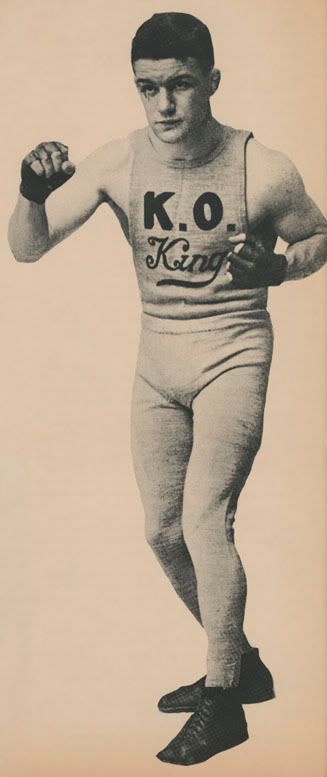
The One They Called Kayo (Boxing Illustrated, July 1963)

1963-07 Boxing Illustrated (pages 42-45)

By AL GOLDSTEIN and JOSEPH T. FRISCIA
The One They Called Kayo

Pound for pound, George Chaney was probably the hardest puncher of all time. He rolled up a remarkable number of knockouts and was that great rarity capable of flattening an opponent with a single blow.

THE CHANEYS WERE LUMBERJACKS: axe-swingers tearing forests apart for profit. The youngest Chaney was a boy named George—and he was the toughest chip off the old Chaney block. George became a fighter, a one-punch killer who knocked out 102 opponents. They called him the "Greatest Knockout Artist of all Time." And to understand his incredible story you must go back to Baltimore: 1910…

…There's a girl in the heart of Maryland with a heart that belongs to me…

Baltimore boys on the make sang that song. George Chaney sang it, too. He was 18. It was spring. The girl had long blonde hair—spitcurled just like Lillian Russell's. "She was the reason I became a boxer," recalled Chaney. "I'd promised to take her to a Fatty Arbuckle movie over at the Nickelodeon. But I was broke—just lost my job at the lumber camp. Then one of my friends told me about Henry Bletzer…"

Henry Bletzer made a modest fortune helping boys who needed money—he tied gloves on their fists. He was a fight promoter.

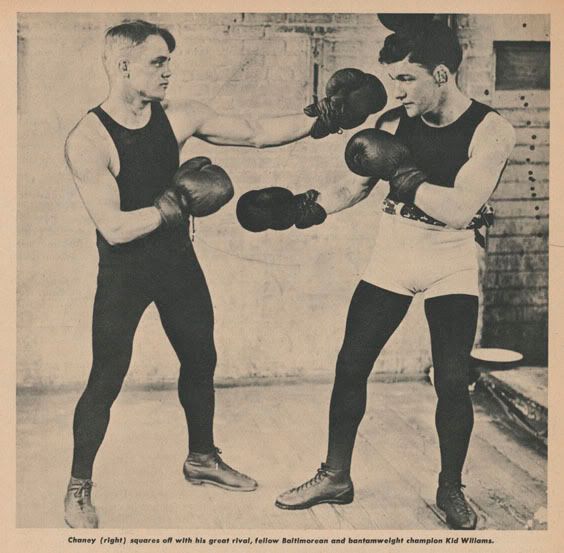
Chaney found Bletzer's cigar-smoky office above the old Albaugh Theater crowded with boys like himself. But when Bletzer mentioned the name Young Kid Williams the office emptied in a hurry. "I was real scared," admitted Chaney. "I'd never boxed before and Young Kid Williams was a brother to Kid Williams—the guy who became bantam champ of the world. But I wanted to take that girl out."

It was Saturday and the Albaugh Theater's patrons filed in film-eyed from an afternoon's beer swilling: They belched and cursed and clamored for the brutality Bletzer was so adept at supplying them with. It was Young Kid Williams' crowd.

"I weighed 112 pounds," remembered Chaney, "and the only trunks they could dig up belonged to a middleweight—so Bletzer fixed everything with a safety pin; and I looked like I was wearing a diaper."

Young Kid Williams had a self-assured sneer on his pug nosed face—a hit-me-and-I'll-get-my brother-after-you sneer. He danced toward Chaney, imitating his brother—but the imitation wasn't good enough. Chaney connected with a left; the punch started in the second digit of his foot and by the time it reached his fist it was a masterpiece of motorized mayhem: capable of cracking bone, crossing eyes, crumpling opponents. And the hapless Young Kid Williams cracked, crossed, and crumpled. The scheduled 4 rounder had ended in 37 seconds.

The crowd began to jeer. Bletzer rushed down to the ringside accompanied by two cops and whisked Chaney to safety. As he pressed $2.50 into the boy's hand he said: "I want to see more of you George; you've got the makings of a champ."

"It's funny," Chaney reminisced, "I can't remember what that girl looked like—but she started it all."

Chaney soon became the Albaugh Theater's main attraction. He walked the streets followed by hero-worshiping youngsters and the eyes of female admirers. He was handsome, with sleek brown hair and matinee idol features…

…No one wanted to smear those features more than Kid Williams—brother of Young Kid Williams. Smelling a big crowd, Bletzer arranged the match. And smelling the blood that trails revenge the fans packed the Albaugh Theater.

Kid Williams was hard-punching and fast-footed. But, as a Baltimore Sun sportswriter observed : "…Chaney's left was the undoing of Williams." They began calling him Chaney—the "Knock-Out Artist".

Commenting on the fight Chaney stated: "Kid Williams was tough; it took three jabs just to mess the part in his hair. He'd keep coming in at me, swinging and dodging. I knocked him down three times but he got up three times. In the sixth round I finally got him: I punched him so hard I could feel the force of the blow through my foot. It took seven minutes to revive him."

But it took a savage brawl with little Charlie Goldman to establish Chaney as a legitimate title contender:

Recalled Chaney: "Goldman was the toughest man I ever tangled with. He became Rocky Marciano's trainer—when I knew him he could've slammed Marciano's gut out.

"I fought him on February 2, 1912—ever since then February 2 has been Friday the 13th on my calendar. For eight rounds those Goldman punches kept coming thick and fast. I tried my best to fight back but he kept hammering me around the ring—I could've sworn he had a baseball bat.

"He knocked me down nine times, and each time—don't ask me how—I managed to get up before the referee counted ten. My face and chest were so swollen I felt like I'd gained 20 pounds.

"But in the 9th round I could tell he'd punched himself out—he was only smacking me halfway across the canvas. And I started to do some smacking of my own: I rammed away with both fists; but Goldman took it as good as he'd given it.

"Then in the 15th it happened—I shot a left to his chin; his loveable brown eyes read 'tilt' and he collapsed. But the bell beat the referee and Goldman was spared the K.O. The referee raised my arm in victory—and an hour later I lowered myself into a hot tub of Epsom salts; I never felt such fatigue in all my life."

George Chaney became big money—you could smell it on him. And Baltimore's biggest bloodhound soon picked up the scent…

…His name was Sam Harris; he was a manager. He collected pedigree bull dogs and promising boxers—the first for fun, the second for profit. Harris said the magic words and an Ali Baba's cave of golden bouts opened for George Chaney.

Chaney celebrated with friends at a Baltimore Beer Garden: He loved parties; loved the sound of popping corks and giggling girls. He loved good food: Chateaubriand steaks for all. He loved to laugh; at Fatty Arbuckle antics and well-told jokes, and even his own shortcomings. He loved being well-dressed: pin-stripped suits, lemon-yellow shirts, diamond studded cuff links in the shape of boxing gloves, cream-colored spats. And he loved music: mounting the bandstands he sang his favorite tune in a determined, if sour-noted, soprano voice…

…Oh Jim O'Shea was cast away upon an Indian Isle
The natives there they liked his hair
They liked his Irish smile…

…George Chaney loved life; and because fighting is part of life he loved to fight. But there were days of bitterness—like the 20th of April 1913, when he fought Abe Attell.

Attell, who'd lost his featherweight crown to Johnny Kilbane a year earlier, was, at 30, admittedly past his peak. And his part-time job as bodyguard to New York gambler Arnold Roth-stein hadn't endeared him to the Chaney fans who packed Baltimore's Empire Theater.


But the ex-champ compensated for age and a hostile audience with experience and craftiness: For five rounds he avoided Chaney's left with peerless footwork; and bloodied Georgie's nose with a lightning fast left-jab. "He never stopped jabbing," said Chaney. "The blood kept trickling down my throat and at the end of the fifth I puked up a bellyful."

"I knew I was losing, so in the sixth I made a desperate rush—and landed a left hook. It staggered Abe and must've scared him because he went into a shell.

"I shortened my punches and began infighting instead of roundhousing." By the 13th round Chaney was battering the ex-champ around like a beach ball. It is a tribute to Attell that he finished on his feet.

Yet referee Billy Joh, the fight's sole judge,. declared Attell the winner.

"If Joh had buried an axe in my head," confessed Chaney, "he couldn't have hurt me more. I tried to put up a good front but when I was alone in the shower … I cried."

Three days later the Maryland Boxing Commission barred Joh from further work. Baltimore's old-timers still talk about the long arms of Arnold Rothstein.

But happiness followed tragedy in the person of a young girl named Elizabeth Fleischer: She married Chaney after a whirlwind courtship.

Relates Elizabeth: "George was handsome and full of life—I fell for him at first sight. He was so manly; and yet, in many ways he was like a little boy: Above everything else he loved Christmas; he'd search for hours till he found the tallest tree and the brightest decorations. He dressed up like Santa Claus and visited the city orphanage with a bagful of toys. But he was careless with his money—knowing this he put financial matters in my hands. I saved every penny he gave me; I swore he wouldn't wind up broke like so many others in his profession."

Elizabeth Fleischer was the last happy thing that would happen to George Chaney.

He made his first title bid against featherweight king Johnny Kilbane on September 4, 1916. Kilbane, who was to wear the 125 lb crown for 12 years, dumped Chaney in three rounds:

"I was beaten before I entered the ring," claimed Chaney. "I had over-trained; I was nervous and lacked stamina. Even so I had Kilbane screaming for help in 50 different languages —including Chinese. But he stuck his thumb in my eye. I couldn't see a thing and he was able to hit me at will. I folded up in the third round and Kilbane kept his title—I should have won, it wasn't fair."

Observed one sportswriter: "George Chaney may be the greatest knock-out artist of all time— but his boxing skill and footwork are poor. It is his tremendous fighting heart alone which makes him a serious contender."

America had entered the First World War: Chaney toured his home state with comedian Charlie Chaplin on war bond drives. One day George asked about Chaplin's middle name and the impish funnyman replied: "It's Spencer—and yours must be Knock-Out, signed K.O." It stuck, and from then on he was referred to as George "K.O." Chaney.

Chaney again tried for a title in 1921, challenging Johnny Dundee for the junior lightweight championship at Madison Square Garden. For four rounds Dundee gave Chaney a cruel boxing lesson. And when Chaney sensed defeat he became desperate. Early in the fifth round he delivered one of his patented southpaw wallops to the midsection. Dundee dropped to the canvas, screaming, clutching his groin. The referee quickly stopped the fight and awarded the decision to Dundee on a foul.

"It wasn't a foul at all," roared Chaney. "The promoters wanted Dundee to win. If you foul an opponent in New York you don't get paid—the fact that I got my check proves I didn't foul Dundee."

But Chaney ran out of excuses when he made his third unsuccessful title bid in a lightweight elimination tournament at Madison Square Garden on February 23, 1925.

The 135 pound throne had been left vacant when Benny Leonard retired undefeated. Chaney was one of a number of pretenders to the title, including Jimmy Goodrich (the eventual winner), Stan Loayza, Joe Dundee, Charley O'Connell, Tommy O'Brien, and Eddie (Kid) Wagner.

Chaney, best known and most respected puncher of the lot, was the favorite. He was matched with O'Brien. It was even money he would win by a knockout; 4-1 that he'd win by decision if it went the distance.

"I was so sure I'd win," recalled Chaney. "I floored him in the first round and he just beat the count. Then I buried my left so deep in his belly I could almost feel his backbone.

"But the kid had a great pair of legs and he danced away from me for the next three frames. Then he clipped me with a right early in the fifth. I got up and somehow managed to last out the round.

"He was too fast for me, too young. In the sixth he connected with a right cross, a left uppercut, then another right. He knocked me cold. I lost all hope of ever becoming champ."

Ironically, that same blow also ended O'Brien's hopes. A post-fight examination revealed that he'd broken his right hand delivering the knockout punch.

"I felt sorry for that kid," confessed Chaney. "He beat me fair and square and he really deserved a shot at the title."

Commented one reporter: "The fight was a tragedy for O'Brien and a sad ending for the once great George (K.O.) Chaney."

The disillusioned Chaney fought only once more before hanging up his gloves. He faced a novice named Danny Kramer—and was knocked out in the first round. "I'd kayoed Kramer in 32 seconds a year earlier," said Chaney, "and when he kayoed me I knew I'd slipped far enough. It wasn't hard for my Elizabeth to get me to quit before too many punches made me permanently dizzy."

But he didn't quit soon enough: Things went well for a while; he lived comfortably on the ring proceeds his faithful wife had saved. He became active in local politics and rose to the presidency of the Georgetown Democratic Club.

And like all ex-fighters he criticized the modern generation of ring-men: "The kids fighting today," he claimed, "are just a bunch of punks. They're not properly developed before they begin their careers. And they don't fight for the sport of it—they're only interested in easy money."

But in 1947 George began to develop lingering headaches; he began to stutter and strain over the simplest words; he couldn't remember the names of his closest friends—the name of his wife—even his own name…

…For George (K.O.) Chaney punchdrunkenness, like cancer, proved to be progressive.

On the 11th of May, 1954, he was placed in a state institution. He died four years later on the 20th of December—five days before his favorite holiday, Christmas.

He'd kayoed 102 of his 183 opponents—only Young Stribling (with 126) and Archie Moore (with 135) surpassed him.

He was probably the greatest puncher, pound for pound, of them all.

Sunday, June 19, 2011

1917-06-19 Fred Fulton W-TKO7 Sam Langford [Armory Athletic Association, Boston, MA, USA]

1917-06-20 The Boston Daily Globe (Boston, MA) (page 8)
LANGFORD QUITS, STARTING SEVENTH
--------
Sam Declines Any More of Fulton's Punishment
--------
Colored Boston Heavy Takes a Hard Drubbing at Armory A. A.
--------
Sam Langford, the colored heavyweight, regarded by many at one time as the best fighter in the world, quit cold to Fred Fulton, the Western heavyweight, when the seventh round of their bout was called at the Armory A. A. last night.

The big crowd was surprised, for they never expected to see Sam playing that role. He has always been game, but the walloping Fulton gave him was enough to discourage most any boxer.

That Langford was not knocked out by Fulton was somewhat of a surprise. It looked in the second as if the Westerner would end Sam's career as a boxer with a knockout.

Fulton stood head and shoulders over Langford and was in great shape, except his hands, which bothered him to such an extent that before he went into the ring a physician treated his left. Judging by the way he used it, however, no one would think that there was anything the matter with it.

Fulton knocked Langford down in the second round with a left hook to the jaw. He took the count of nine and was badly dazed when he got to his feet. Fulton drove his left time after time to Langford's eyes, mouth, nose, jaw and stomach. When Sam quit his eye was closed tightly.

The Western giant did some handy work, too, with the right, planting many rights to Sam's jaw. In the fourth, one of them nearly put Langford to the mat again. By grabbing Fulton about the waist he kept on his feet.

Not content with banging Sam on the jaw with his right, Fred also shook Sam up many times with short right-hand uppercuts.

Fulton fought a careful battle, in a cool manner, but did not escape some of Sam's punches. He did not seem to mind them much, however. Sam did not have a chance to reach Fulton a great many times, for the latter blocked many vicious left hooks Sam sent for the stomach and jaw. Fulton's left also kept Sam back most of the time when he worked to get close to his tall opponent.

At times Fulton made the once great fighter look like a crude amateur. It looked several times as if Langford was trying to lose on a foul, as some of his blows were low, but they did no damage.

When he went to his corner at the end of the sixth round he looked about all in. Bill LeClair sounded the bell for the start of the seventh and Langford's seconds jumped out of the ring. The fans expected to see Sam start again, but he remained seated and shook his head to the referee. His seconds went to his side and after a brief talk one of them threw in the sponge. Fulton did not have a mark on him.

Matt Hinkel of Cleveland refereed the bout.

To add to Sam's discomfort he was arrested in the afternoon by Deputy Sheriff C. Reardon, on a writ sworn out by Pete Walker, who claims that Langford owes him for services rendered. A friend of Langford's went his surety and he was released.

In the semifinal bout Jack Savage of Brockton made Al Nelson of Manchester quit in the fourth. Teddy Murphy won the decision over Charlie Mitchell in six rounds, and Jerry Leo and Charles Miller boxed a six-round draw.

Chick Simler and Frankie Callahan will box in the feature bout at the club next Tuesday night.


1917-06-20 The Boston Journal (Boston, MA) (page 8)
LANGFORD QUITS TO FULTON IN SEVENTH ROUND OF BOUT
--------

By Jack Malaney

Some three, four, or maybe five thousand fistic fans, local and visiting ones, went to the Arena last night and saw an old Boston favorite, Ho Ho Sam Langford, get left-handed to defeat. Deciding that prudence was the better part of valor, Sam refused to answer the bell in the seventh round, and there was nothing else for Referee Matt Hinkle to do but to award Fulton a technical knockout.

As a heavyweight battle it was practically a joke. The sizes of the men made it so, if nothing else did. Everybody knew that Fulton was a giant and that he was going to be much taller than Sam, but it was not until they got together in the center of the ring for instructions that the crowd really realized how much taller than Sam Fulton was.

Helped Sam Decide

And it was that disparity, also Fulton's great advantage in reach, that made Sam decide that he had taken enough. It didn't take any great amount of brain work or even common sense on Sam's part to know that he didn't have a chance. For any man who has been hit 307 times, or somewhere in the vicinity of that number, with one sort of punch alone, said punch being a straight left-hand jab, besides numerous other punches from both right and left hands, in only six rounds, should know where he gets off.

It was just like the pride of the village, an accomplished boxer, taking on the tough little guy from the next town. There had been many who thought that everything would be arranged for Fulton to "get" Sam in order to re-establish himself as a heavyweight of note. If those who thought that were present and saw the affair they soon became convinced that Frederick didn't need to have any fixing done for him, that it was almost simple for him to whip Sam with everything up to snuff.

Kept Left Working

Not only did Fred continually keep shooting that left hand at Sam's face until his nose was sore, his left eye closed and his lips were well cut and bleeding, but he also scored a sure and clean knockdown. In the second Fred had started out from where he left off in the first, jabbing to his heart's content. Sam got peeved and rushed in close. Fulton quickly shot a left hook to the head and Sam went down and stayed down for nine counts.

Besides that straight left, Fulton showed that he had several little items of offense in his repertoire. Against Langford, he had what could be called a fine one-two. After shooting his left straight several times, Fred's right would then come out straight from the shoulder. That his left hook is a fine one was asserted when he dropped Langford with it.

Failed to Prove Class

With all his fine showing last night, Fred failed to prove that he is the best heavy in the game. He lacked aggressiveness and he was not a bit vicious, a something that is getting to be common in heavyweights. Of course, his lack of aggressiveness last night could be credited to cautiousness, for he knew well that the Langford punch is dangerous. But with the battle going along so easily for him as it was, he could have extended himself a little more and tried to stop Sam, which he didn't even try to do.

Fulton has got plenty to learn yet about his defense. There, again, he might have an alibi on his defense of last night. Langford was so much shorter that it perhaps was better for Fred to keep his hands down around his mid-section most of the time. But when Fulton punched, that is, outside of jabbing, the inactive hand would invariably drop and leave him open.

Fulton Stood Guff

It has been said that Fred doesn't like to get hit hard. He didn't show it last night, then, if he doesn't. Langford may not have landed as hard on him as he wanted to nor as squarely as he generally likes to hit an opponent, but he certainly did connect with Fred and more than once. Not only did Fulton's body get walloped properly hard at times, but his head came in contact with Sam's padded fist sufficient times to warrant the saying that he is not punch-shy. And he took many of Langford's blows gracefully, too, having acquired the knack of letting his head go away from the wallop and thus escaping the full force of the punch.

Nelson Calls Halt

Like the feature event, the semi-final contest likewise ended. In this Al Nelson of Manchester decided that he had received enough from Jack Savage in the fourth round. Nelson had gone down a couple of times in the third and several in the fourth before Referee Conley stopped the bout.

Teddy Murphy proved too clever for Charley Mitchell in their six-rounder and won out. The crowd didn't like the decision, for Mitchell is a big favorite and Murphy is not, but it was a right one. In the opening six-rounder Charley Miller boxed a draw with Jerry Leo.


Bob Dunbar's SPORTING COMMENT
--------
"Every knock is a boost"--Bob.
--------
Fulton is remarkably nifty and speedy for such a big fellow, even allowing for the contrast between his pace and Sam Langford's slowness at the Triple A. last evening. But nobody was convinced that Fred is the man to take the heavyweight crown away from Willard. He does not even seem to have the temperament of a scrapper, although Jess is also a very good-natured off-hand sort of a chap. Fulton would better not wear that Glacier Park bathrobe into the same ring with the Cowboy until a few more winters and summers have passed over the heads of both.
*
Ho Ho Langford, being under no obligation to demonstrate courage after 15 years in the ring, did a perfectly sensible thing when, with one eye shut tight and the other a mere slit, decided to remain in his corner after the six rounds were over. He was practically helpless--and no championship was involved.


1917-06-20 The Evening Times (Pawtucket, RI) (pages 12, 17)
LANGFORD QUITS TO FULTON
--------
Beaten Badly From Start, Tar Baby Refuses to Leave Corner In 7th Round.
--------
KNOCKED DOWN IN SECOND
--------

(By Staff Correspondent.)

BOSTON, June 20.--Rather than let the white giant knock him out for the first time in a ring career that dates back 15 years Sam Langford, the Boston Tar Baby, refused to come out of his corner for the seventh round of his bout with Fred Fulton of Hudson, Minn., at the Armory A. A. last night. Knocked down cleanly by a wicked short left hook to the jaw in the second round, one eye almost closed after the fourth from Fulton's steady jabs, and discouraged by his inability to score with his former deadly left hook, Sam Langford, the terror of his class for years, was licked and he knew it. Matt Hinkel, after the bell clanged in the sixth, waited for Langford to come to scratch and when the bulky negro continued to sit blinking in his chair the Cleveland referee gave Fulton the bout.

Thus did Fulton, an aspirant for Willard's honors, emulate against Langford the success of Jess the circus proprietor against Jack Johnson. Up to last night no white man, since the days Langford has been recognized as one of the "greats," has ever stopped the Boston Tar Baby. There is no question but what Fulton, who had height, weight and reach on Langford, would have won on a knockout had the bout continued much further. Langford was helpless before the big fellow. It was like a baboon fighting a giraffe. Langford seldom was able to break through Fulton's guard and in the second round Fulton floored him heavily with a left drive that forced the negro to take the count of nine.

Not Yet Ready for Willard.

In kicking from the heavyweight track the last chunk of coal Fulton partly obliterated his recent sorry showing against Carl Morris. The ponderous plasterer from Minnesota does not appear, however, a formidable opponent for Willard. He has a good stiff left hand and a right cross that is fairly effective, but he is slow and lacks confidence. Any time after the second round Fulton should have been able to beat his old, puffy opponent. The fact that Langford surrendered before the bout had gone more than half the distance indicates clearly how far he was gone.

Fulton was the first to enter the ring. The western giant wore over his togs a gaily decorated Navajo bathrobe that made his great height all the more conspicuous. He was attended by Al Palzer and Fouler Mike Paulson, who took turns fanning him until Sam Langford, accompanied by a dusky retinue, put in a belated appearance.

Fulton Towers Above Langford.

When the men met in the centre of the ring the marked discrepancy between the combatants raised an amused howl from the crowded house. Langford, with huge rolls of fat around his bronze stomach, came only up to the shoulder of the blond, clean-limbed giant. Even as the six-foot fighter from Minnesota bent over to hear Referee Hinkel's instructions he was fully a head taller than anybody else in the ring.

Fulton lost no time getting his famous left hand working the minute the bell rang. Langford took four or five jabs and then tried to put over a left chop but missed by yards. Fulton jabbed again and then shot over a hard right. Langford sent his right and left gloves to the body with no effect and Fulton in response popped him on the chin with both hands. For the remainder of the round Langford coolly took jab after jab, vainly trying to break through Fulton's guard.

Fulton Drops Langford Cleanly.

The westerner resumed his jabbing in the second round and, suddenly, as Langford rushed him into his own corner, Fulton set himself and shot a short left hook straight to the negro's chin. Langford dropped, as if shot, upon his haunches, rolled over like a barrel and amid a perfect frenzy of cheering took the count of nine. When he got up Fulton tried hard to rush him, but the crafty ring general was soon himself again and finished the round strong.

In the third Langford started to cover more, but when the Tar Baby blocked leads for his head Fulton began to shoot punches to the body, so Langford again pursued Fulton in the hope of getting close enough to land his left hook. Invariably the punch whistled harmlessly short of the mark. Langford, however, held Fulton even in this round, the only one that Fulton did not carry.

In the fourth round Fulton laced Langford so steadily with his left that one good right-hand punch seemed all that was necessary to jolt the negro off his pins, but despite the exhortations of the fans to "Knock him out, Fred!" the plasterer took no chances and kept the Boston heavyweight at long range.

Sam's Last Shot Fails.

Fulton kept stepping in with his stiff left in the fifth and although Langford twice rallied and hammered him in the body Fulton only grinned and kept raking the Tar Baby. This inability to hurt Fulton must have had as much to do with the negro's quitting as Fulton's blows. In the sixth round he showed signs of despair after a last coup failed. Working Fulton into a favorable position for such a move, Langford suddenly lashed out his left hand and smote Fulton a wicked hook flush on the jaw. It was the old Langford punch--the kind that used to make men's knees knock together. But Fulton only grinned as the blow bounded off his chin, and from then on to the end of the round Langford gave up hope and simply tried to block punches. It was evident, when he failed to come to scratch in the seventh, that he had put his all in that punch and, failing, had decided that further resistance was useless.

The semi-final was also an abbreviated affair. Al Nelson of Manchester bothered Jack Savage of Brockton for one round with his left jab, but after that Savage's punches broke through Nelson's defense, and in the third Savage flattened the Manchester middleweight with a heavy right smash to the body. Savage floored Nelson twice more before the round ended and was making a punching bag of him when Referee Larry Conley stopped the bout in the fourth. Nelson hit the floor three times in this round.

In the preliminaries aged Teddy Murphy was given a doubtful decision over Charlie Mitchell and Charley Miller and Jerry Leo boxed a draw.


Langford Meets Legal K. O.

BOSTON, June 20.--Sam Langford was arrested yesterday afternoon on a complaint made by Peter Walker, a trainer, who alleges that Langford is indebted to him in the sum of $1138 for services. The arrest was made by Deputy Sheriff Reardon of Sheriff Kelther's staff. Bonds were furnished for the heavyweight boxer by George Dearborn, a local hotel man.

Saturday, June 18, 2011

1903-06-18 Joe Walcott D-PTS20 Young Peter Jackson [Balanee Box, Portland, OR, USA]

1903-06-19 Morning Oregonian (Portland, OR) (page 11)
FIGHT CALLED DRAW
--------
Joe Walcott Escapes Losing His Title.
--------
FIERCE BATTLE FOR 20 ROUNDS
--------
Young Peter Jackson Makes a Game Try for Welterweight Championship, but Lacks a Knockout Punch.
----
Joe Walcott, the world's champion welterweight, came nearer losing his title in his battle last night with Young Peter Jackson than he has since he gained the title. For 20 rounds both men fought one of the fiercest and gamest battles ever seen in Portland, and while Referee Jim Neil called the fight a draw at the end of the 20 rounds, the last five rounds were largely in favor of Jackson.

The fight was for the welterweight championship of the world, and if Al Herford, Peter's manager, had his way, and the fight had gone 25 rounds instead of 20, there would have been a new welterweight champion this morning. Walcott fought his usual clever and masterful battle. During the earlier rounds his ducking, leading, blocking and ring generalship made Peter look as slow as a carthorse compared with him. But Peter was fighting under instructions, which were "bore in all the time; take what's coming, but always keep covered." And how closely he followed these instructions showed as the battle waged. And it was a battle, for round after round the two black pugilists clashed, smashed and walloped each other until it looked as if both fighters would fall from sheer exhaustion. But they did not. At the sound of the gong, which brought them to their feet, Joe and Peter were at each other, with Walcott ripping rights and lefts to the body and head and Jackson jabbing a straight left to the face, and then in the clinches working both hands like pistons on a donkey-engine.

Fighters Go a Fast Pace.

Not a one of that great crowd present, after Peter and Joe got mixing it, ever dreamed that the fight would go to the limit. It seemed, at the pace they were fighting after Walcott had sent Jackson to the canvas in the second round with a right swing that nipped Peter on the cauliflower ear, that one or the other of the boxers must take a peep into pugilistic dreamland, where the fighter, like in a dream, wakes to half-consciousness to hear his master receiving the plaudits and cheers of the crowd. But the fight grew faster and faster as the great bell over in the official timekeeper's corner tolled off the rounds. And with each round Jackson began to unlimber. He seemed to grow stronger. He straightened out of his smothered pose and started after the champion and kept after him until he had Walcott holding in the clinches in the last two rounds. As Jackson grew strong, Walcott, while he lost none of his skill at ducking, his blows seemed to lack steam, and his judgment of distance became less accurate. It was Jackson's straight left that kept reaching Walcott's face that was beating the champion. He realized it as well as the crowd, which, during the earlier stages of the fight, was with the Black Demon from Boston. But when Jackson's stinging left repeatedly found lodgment against Walcott's jaw and face, his right smashing into Joe's wind, or ripping an upper cut which sent Walcott's head back with a snap, the tide of favor turned, until in the 18th round the crowd was yelling like mad and howling, "Jackson! Jackson!" Jackson tried manfully to deliver what the crowd wanted--a knockout punch--and it was only because of Walcott's ability to stall that saved him.

Walcott Grows Serious.

Of course, Walcott doesn't think he was anywhere near beaten. His seconds share his opinion, but it was noticed that the laugh was no longer tripping merrily from the lips of the Barbadoes Wonder. There was no longer the ready jibe and witticism; instead, the black from Boston was serious--as serious as a miser counting his hoarded wealth. The yawn and the assumed air of sleepiness had also disappeared, and on his ebon face there was an expression of anxiety and consternation. He was fighting to save his title, and no longer to hear the laugh of the crowd. All this time Jackson, like a mole working under ground, was wearing his antagonist down. In the 19th round a series of lefts to the face, and a number of herculean uppercuts had the champion wobbling and rocking like an old-fashioned cradle. At that Walcott was at all times dangerous, and, although badly weakened, there was a knockout punch lingering in those brown arms. Jackson knew this, and he never became careless; in fact, all through the rough journey both men fought hard, but carefully.

There was the usual delay in getting the men in the ring, and even after they were in the arena there was a short parley about the number of rounds. Herford wanted the men to fight 25 rounds, but Walcott would not consent, and they finally settled on 20 rounds. The men were brought to the center of the ring and introduced. Dixie Kid was introduced, and offered to fight any man in the world at 145 pounds. Jackson and Billie Woods are matched, and the fight will be pulled off in San Francisco.

--------

MEMSIC WINS PRELIMINARY.
----
Snailham's Seconds Throw Up the Sponge--Ah Wing Boxes.

The crowd as usual was on hand early and as the hour for starting the mill rolled around there were the usual calls for the fighters, Ah Wing and Ed Wiley. At 8:45 Ah Wing with his queue stuck in the rear of his tights, was first to show. The crowd yelled him a loud welcome, and the cousin of Wu Ting Fang smiled in return. Wiley is Wing's sparring partner, and the round exhibition pleased the crowd hugely. The Chinese was clever and demonstrated that he knew something of the boxing game. In the third round both boxers gave a fine exhibition of light slugging. In the fourth and last round Wiley allowed the chink to wallop him and gave a show how the knock-out is delivered.

It was 9 o'clock when Mike Memsic, followed by his seconds, entered the ring. Dick Memsic, his brother, and Joe Cotton were in his corner. Snailham followed shortly and he was looked after by Fred Newhouse and Mike Sullivan. Billie McClain, Dixie Kid's manager, officiated as referee. The boys were a trim-looking pair and looked to be in fine condition. It was Dick's initial appearance and he showed himself a bit of a master of the game. Snailham had only a right that he tried frequently, and missed just as often, for the wind. Memsic's straight left jab soon had the Californian in distress. In the second round Memsic used both hands effectively and just before the bell Memsic sent Snailham down with a right to the jaw. Just as he got to his feet the gong sounded.

Memsic tried to finish the battle in the third round, but his blows, while they punished greatly, lacked steam. Snailham was the gamest kid that has boxed in Portland for days. He gave away at least five pounds and certainly was a glutton for punishment. The crowd liked the Bay City kid's gameness and cheered him roundly when he landed a stiff punch. Snailham came back strong in the sixth round, and he had a shade the better of the argument. Snailham's ankle went to the bad early and he limped painfully, but in spite of this and the beating he got he kept coming back for more until about one minute and a half of the ninth round, when his seconds threw up the sponge. His ankle as much as anything helped make him quit. The fight was awarded to Memsic, who is a good, clever boy.

Friday, June 17, 2011

1907-06-17 Jack Blackburn ND6 Terry Martin [Washington Sporting Club, Philadelphia, PA, USA]

1907-06-18 The Philadelphia Inquirer (Philadelphia, PA) (page 9)
WERE YOU DOWN?
--------
By Great Effort Blackburn Permits Martin to Stay Six Rounds

Jack Blackburn had the time of his career at the Washington Sporting Club last night in his wind-up with Terry Martin. He had gone through many a tough mill in his brief, but meteoric experience, but never before has he been compelled to utilize all his resources. But he was game--game as a pebble, and though he was a footsore, tired and weary he won out. Martin was there at the sound of the bell at the end of the sixth round, and the sure thing players who wagered as high as 2 to 1 that Martin would stay had a shake fest.

In the semi wind-up Jack Roller, of Brooklyn, stopped Johnny Murray, of this city, in three rounds. In the preliminaries, Bobby O'Neil and Tony Haney boxed a fast six-round draw. Harry Brady, of Shamokin, and Harry Carton, of this city, also boxed a draw, and Kid Kelly, of Brooklyn, and Tommy Stone, of this city, went the limit with honors even.


1907-06-18 The Philadelphia Record (Philadelphia, PA) (page 8)
BLACKBURN BEAT MARTIN
--------
Colored Boxer Could Not Stop the Tough Little Dane.

Jack Blackburn defeated Terry Martin at the Washington Sporting Club last night, but he could not stop the tough little Dane, who was there doing business at the end of the sixth round, although he was minus four of his front teeth which Blackburn had knocked out during the progress of the contest. After the speedy manner in which Blackburn had put away Fred Bradley it was expected that he would make short work of Martin. Although he hit Terry almost as he pleased during the contest, he was never able to land a blow on the right spot, although he had Martin holding in every round and had Terry's nose and mouth bleeding. Blackburn seemed to be too anxious to end the bout with one punch, and he missed a dozen swinging blows that he aimed at Terry's jaw. There were times when it looked as if the colored boxer was too easy with Martin, for when he would have a chance to land a blow he would draw it back without hitting him. Martin did very little boxing during the progress of the contest outside of the sixth round. He seemed contented to stay and take the punishment. When he was getting it hard he held on and kept his jaws and stomach covered. In the last round, however, Martin made a good rally and fought Blackburn blow for blow for about half the round, and then he went weak, or was satisfied with what he had done, for he started holding again and covering till the end of the round.

In the semi-wind-up Jack Roller stopped Johnny Murray in four rounds. Tony Haney and Bobby O'Neill boxed a hard draw, both being nearly all in in the last round. Tommy Stone and Harry Kelly boxed a draw, as did also Ed Carton and Young Grady.

1905-06-16 Sam Langford W-PTS15 Young Peter Jackson [Douglas Athletic Club, Chelsea, MA, USA]

1905-06-17 The Boston Daily Globe (Boston, MA) (page 3)
LANGFORD THE MASTER
--------
Jackson Should be Content Now.
--------
Boston Boxer at All Times Ahead of the Baltimorean.
--------
Briggs and Coffey May Meet Again.
--------
Young Peter Jackson was defeated for the second time by Sam Langford of this city when the two met last night at the Douglas A. C. The Baltimore boxer should rest content now and admit that he has met his master.

The bout last night was somewhat of a repetition of the contest at Marlboro, only last night Langford was more confident of the result.

There never was a time when he did not feel that he was winning. His left hand jabs found a resting place on Jackson time and again. The visitor resorted to his stalling and blocking tactics, but they availed him very little. When they got to close quarters Jackson got in some good punches, but he found Langford pretty handy at infighting, too.

Time and again on the breakaway Jackson tried to get over his famous right, the punch that knocked Jack O'Brien out twice, but it was no use with Langford.

In the bout at Marlboro Langford got one taste of the dangerous wallop and it came near losing him that battle, so last night he was prepared for it.

When the referee gave Langford the decision the greater number of those present fully agreed that the verdict was the only one that could have been given. Of course, Jackson could not see it, but there was no alternative.

Langford will now seek matches with some of the other pugilists who think they are entitled to the middleweight championship.


1905-06-17 The Boston Journal (Boston, MA) (page 5)
Langford Won From Jackson In Slow Fight
--------
Sam Langford of Cambridge and Young Peter Jackson of Baltimore fought fifteen dreary, weary rounds at the Douglas A. C., Chelsea, last night, Langford winning the decision by all kinds of margins and angles. Jackson did not have any chance for victory except to send Langford down and out. He came within an ace of the point, but "nears do not count."

Langford's work was pretty in the extreme sense of the word. He stabbed repeatedly with the left hand on to Pete's nose and face and the right-hand blow which crashed onto Jackson's jaw was also used often as a supplement to the left-hand jab. The left-hand hook to the body by Langford was also telling. Four times during the contest Langford's right smashed so hard onto the black Oriole's jaw that he was staggered half way across the ring.

Jackson had fifteen or twenty pounds advantage in weight. He pursued the tactics he employed when he showed in this city before and did nothing but stall and cover up and try for one "haymaker." But while Langford was eager to stab and jab with the left and smash with the right on the jaw, he was also wary. He never forgot to guard his jaw, and also remembered that there is such a warning among canal boat men as "low bridge," for he ducked more than once out of harm's way.

Jackson's right, which carries destruction in its path, sailed over Sam's head several times, as he saw it coming.

It was a case of clinch on Jackson's part and to protect himself Langford was also obliged to grapple. Fifteen or twenty times during every round found both boys locked in a warm embrace, working desperately with the free hand.

Kid Lester of Cambridge dropped twice to the floor to avoid punishment. The second time he went on his hands but not his knees. While in this position his antagonist, Harry Edels of Chelsea, punched him. Thereupon the referee disqualified Edels, who had beaten Lester at the rate of fifty to one, overlooking the fact that Lester had gone down to avoid punishment without being punched, a clear violation of the rules.

In the first bout Johnnie Fitzgerald of South Boston won from Tommy Murray of Roxbury. It was all Fitzgerald in the last round, and it appeared a bit brutal. The referee showed good judgment in stopping it. Murray was game to the core and made a good showing till the last round when the tide of battle turned against him.


1905-06-17 The Washington Post (Washington, DC) (page 8)
LANGFORD BEATS JACKSON.
--------
Baltimore Fighter Unable to Get Close to Boston Man.

Special to The Washington Post.
Boston, June 16.--Sam Langford, of this city, knocked out Young Peter Jackson in their fifteen-round fight before the Douglas A. C. members in Chelsea tonight. The colored fighter from Baltimore exhibited a capacity for punishment that only equals Joe Grimm's ability in that line, yet he kept Langford stepping pretty fast to keeo out of the way of his wide swings.

In the last round Langford had Jackson all but gone. The Boston man simply hit Jackson when and where he pleased. Jackson willingly took powerful swings on the jaw in order to get in close, but it seemed impossible for Jackson to get into position to land a punch.

Jackson was groggy and floundering around the ring in the last round.

Thursday, June 16, 2011

1921-06-15 Johnny Dundee W-PTS12 Jimmy Hanlon [Pioneer Sporting Club, New York, NY, USA]

1921-06-16 New-York Tribune (New York, NY) (page 15)
Dundee Gains Judges' Decision Over Hanlon

Johnny Dundee was in fine shape last night in his battle with Jimmy Hanlon at the Pioneer A. C., bewildering the Denver boy with his clever boxing and constantly using a left hook to good effect. At the end of the twelve rounds the judges readily agreed on Dundee as the winner. In the ninth round Johnny sent Hanlon to the canvas with a clean left hook to the jaw, and when Jimmy got up at the count of two, he had a badly swollen lip.

Hanlon tried to outbox Dundee early in the bout, but was battered into submission in every round. In the seventh session he tried a slugging game, but Dundee came right back and outslugged him.


1921-06-16 The Brooklyn Daily Eagle (Brooklyn, NY) (page S2)
Johnny Dundee Gives Hanlon a Boxing Lesson

Johnny Dundee, shifty as ever, gave Jimmy Hanlon, the Denver veteran, a nifty lacing in the Pioneer S. C. last night. Hanlon was on the receiving end in every round, and he very seldom laid a glove on his elusive Italian opponent. On the good showing he made against Willie Jackson in the same ring a month ago. Hanlon was given a chance against Dundee, but the Western lad was up against a decidedly different proposition, and he never did fathom Dundee's jumping-jack tactics.

In only one round, the seventh, did Hanlon show a flash, and here he outfought Dundee in a fierce mixup, making Johnny clinch to avoid punishment. But Dundee immediately after was right on top again, and he landed enough lefts to keep a comptometer busy adding them up. In the ninth round Dundee caught Hanlon with a wicked left that put the Denver lad down for a couple of seconds. The bell was welcome music to the Westerner in this session. Dundee weighed 132 and Hanlon 132½.

In the semi-final Johnny Darcy, who is one of the best of the second division lightweights boxing around these parts, won his third consecutive victory in the Pioneer Club. This time Dick Stosh of Cleveland was the victim. Stosh lasted the 12-round route, but he was a badly beaten lad at the finish. This bout took the place of the scheduled heavyweight battle between Al Roberts and Bill Schellinger.

Sammy Schiff, an East Side lightweight of evident ability, was awarded the decision by Referee Danny Sullivan in his bout with Johnny Marto, because of Marto's foul work. Schiff was giving Marto a severe beating, and Johnny was warned for hitting low several times. In the fifth round Marto, half blinded--his left eye was completely closed--swung a right from his knee and it landed very low. Schiff fell and writhed on the floor with pain, and Marto was properly disqualified.

In the other bouts Al Boyle beat Ole Miller in six rounds, and Marcel Badeau and Harry Harris fought a six-round draw.


1921-06-16 The Evening Telegram (New York, NY) (page S1)
Johnny Dundee Easily Beats Jimmy Hanlon
--------
Jumping Johnny Dundee, the Scotch Wop, took Jimmy Hanlon, of Denver, Colo., over the hurdles last night at the Pioneer Sporting Club and won an easy decision from the Westerner in the main twelve-round bout. Johnny, in the pink of condition at 132 pounds, his opponent a half-pound heavier, never was in danger and had the Denverite so confused he was unable to hit where Dundee was.

The ruggedness of Dick Storsch, a Clevelander, saved him from a knockout at the hands of Johnny Darcy, of the West Side, in the semi-final twelve-round go. Darcy was awarded the decision.